

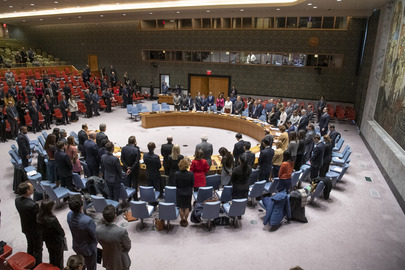
When global leaders gathered at the UN during High-Level Week at the organization’s headquarters in New York, AI emerged as an issue which both unified and divided nations.
Although they largely agree there are significant upsides to AI, they are split on the risks, who writes the rules, and how to stop entire countries from being left behind.
UN News reviewed some of the key speeches made during the UN General Debate to get a sense of the challenges and benefits that nations are focused on.
AI has supported breakthroughs including speeding up medical diagnoses.
As UN Secretary-General António Guterres put it: “AI is indeed a game changer — with enormous promise to advance medicine, accelerate scientific discovery, expand opportunity, and improve lives.”
Innovation vs safeguards
Countries seemed focused on finding the right balance: How can we push the positive aspects of AI technology forward without opening the door to disaster at the hands of rogue agents?
President of the General Assembly Khalilur Rahman put it plainly: “AI can be a powerful accelerator of human progress; therefore, we must not close the door to innovation.”
But he also flagged the potential harms; job losses and deepening digital divides while calling for guardrails grounded in science, not fear.
Switzerland struck a similar note, warning that regulation needs to build trust without choking off AI’s benefits. Japan zeroed in on cooperation over frontier AI safety.
Saudi Arabia leaned into ethics and responsible use. Singapore backed testing, trust-building and cross-border incident reporting, while flagging the dangers of increasingly autonomous systems.
Mr. Guterres framed the challenge starkly: “The danger is not technology. The danger is technology without accountability: Capability without oversight. Decision-making without transparency.”
People not processors
Once the policy talk is stripped away, most countries are asking: what does this mean for daily life?
A technician maintains solar panels at a hospital in Bulawayo, Zimbabwe.
The UK talked up faster cancer diagnoses, economic renewal and better public services. India went further, describing AI as a ground-breaking development tool: “We view AI as a transformational driver, for human empowerment, economic prosperity and population-scale problem solving.”
The UK also focused on the potential disruptions. “But we know that AI will also be a source of disruption to the way we live and work, and a multiplier of risk.”
The solution? Keep humans, specifically, elected ones, in charge: “Fundamental decisions on this technology are too important to be left to chance. They must be taken by elected governments who serve working people.”
These concerns reflect a broader debate over whether AI will shrink or deepen inequality.
Who writes the rules?
Another recurring question was whether countries will merely use AI or help shape its future.
South Africa was direct: Africa needs a hand in writing those rules, tying it to research, youth and economic transformation. Switzerland agreed that real participation means shaping governance, not just getting access.
India pushed for sovereignty: “We believe in the right of each nation, to shape its eco-system, with the development of its own models, and deployment strategies, consistent with its national goals and priorities.”
Meanwhile, China focused on ensuring that technological advances are shared broadly rather than concentrated among a few countries or societies.
“We should take a people centered approach and develop AI for the positive and for good, narrow the digital divide and promote development that is universally beneficial.”
Diplomats meet at the UN in Geneva to discuss AI Governance.
Singapore went further still, floating the idea of a future UN framework convention and a dedicated international AI institution, with everyone, not just the frontrunners, at the table.
The UN has already started bringing countries together to discuss the issues raised by AI including establishing an Independent International Scientific Panel on AI and holding a Global Dialogue on AI Governance
The real currency: Power and access
The concentration of data, computing power and influence remains a significant worry for many nations.
Brazil flagged the outsized sway of big tech companies. France raised the risk of dependence on either dominant States or a handful of private firms.
Developing countries want to play a bigger role in digital development, urging more access to increased computing power, technical know-how, infrastructure, and a significant say in setting standards.
China tied this to the digital divide, South Africa to participation in research and governance, Saudi Arabia to capacity-building institutions and Switzerland to skills and infrastructure support.
Data centres like this one are driving the AI revolution.
The takeaway: The future of AI may be as much about access as it is about regulation.
Keeping humans in the loop
Security concerns emerged through plenty of speeches.
- France flagged risks around defence, cybersecurity and space.
- Japan pointed to information integrity and increasingly powerful frontier systems.
- Türkiye called for an international legal framework.
- Ukraine warned that the more capable this technology gets, the more urgent the search for peace becomes.
- Singapore added its voice to worries about autonomous weapons and the loss of human control.
So, how much global oversight?
While many nations favour the idea of cooperation, finding common ground on how far it should go, remains problematic.
Russia backed UN-centred rulemaking with universal buy-in. Türkiye pushed for work on a UN convention on AI. The UK called for global principles and standards, and said AI will be a headline issue when it takes the G20 presidency.
The UN chief went furthest, laying out concrete proposals including stronger safeguards, independent oversight, a new risk-management architecture: “But because this affects us all, global coordination is indispensable,” he told the General Assembly.
Not all sovereign governments are convinced tighter controls are the answer. The United States offered the sharpest counterpoint, treating AI dominance as a strategic and economic imperative.
President Donald Trump argued for an alternative vision: “I’m not going to stifle growth of something that will be bigger than the Industrial Revolution. Many say bigger than the Industrial Revolution or the Internet itself.”
Source of original article: United Nations (news.un.org). Photo credit: UN. The content of this article does not necessarily reflect the views or opinion of Global Diaspora News (www.globaldiasporanews.com).
To submit your press release: (https://www.globaldiasporanews.com/pr).
To advertise on Global Diaspora News: (www.globaldiasporanews.com/ads).
Sign up to Global Diaspora News newsletter (https://www.globaldiasporanews.com/newsletter/) to start receiving updates and opportunities directly in your email inbox for free.