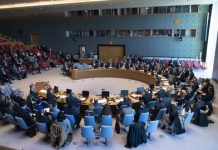

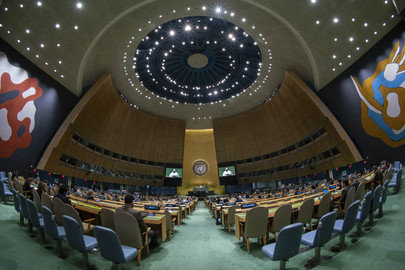
Security Council discusses escalating Russian attacks against Ukraine
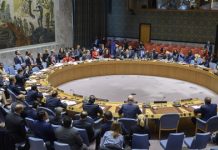
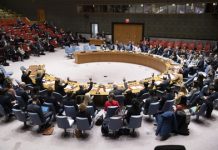
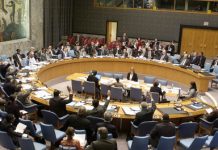
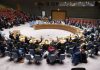
The UN Security Council is discussing the war in Ukraine amid escalating Russian missile and drone strikes against the capital Kyiv and elsewhere.
Since the Council last debated the on-going invasion earlier this month, more than 170 civilians reportedly have been killed across the country due to intensified Russian aerial attacks, said Kayoko Gotoh, a senior official in the UN Departments of Political and Peacebuilding Affairs.
She told ambassadors that Kyiv has remained under constant bombardment.
“Just yesterday, the eighth major missile strike on the city this month, struck a residential building. Three people were reported injured. In July alone, at least 56 civilians have reportedly been killed and 232 injured in Kyiv.”
Ms. Gatoh added that with daily attacks also being reported in frontline communities in the Donetsk, Kharkiv, Sumy, Kherson, Dnipropetrovsk and Zaporizhzhia regions, “the summertime escalation has had an increasingly destructive impact on the areas of Ukraine temporarily occupied by the Russian Federation.”
Sudan UNICEF: The more health centres we build, the more children come
To Sudan, where aid teams working on the ground have underscored massive health needs among people in South Kordofan state who’ve been uprooted by war.
UNICEF Representative in Sudan, Sheldon Yett, described how the agency supports specialized nutrition centres for displaced mothers and their babies who are often extremely malnourished.
Here’s Mr. Yett now at Abujubayha Hospital Stabilization Centre in South Kordofan, where starving children require at least one week of specialist care before they’re healthy enough to leave:
“These are children who have fled violence, who have fled communities that have been cut off because of conflict… I spoke to one mother whose son, Abu Beta, had been here for just three days. Abu Beta was getting better. Abu Beta looked very thin, but Abu Beta was also getting very targeted critical support. His mom I was very hopeful that they’d be able to go home soon. The more health centres we seem to put in place, the greater the demand there is.”
Mr. Yett described how mothers often walk for “miles and miles” in search of help for their children who depend on UNICEF and the agency’s partners, well over three years since rival militaries in Sudan went to war.
The health of the country’s children will continue to deteriorate unless they can access health facilities that are stocked with sufficient supplies – and with dedicated staff who have the training required to help them, the UNICEF official stressed.
South Sudan hunger needs are growing among children: UNICEF
An update now from South Sudan, where aid teams have been providing emergency support at a displacement camp hit by flash-flooding and a deadly cholera outbreak.
Bentiu camp in Unity state has provided shelter to more than 100,000 people for well over a decade.
Many residents originally sought safety there and in similar sites while fleeing from the ongoing civil war that erupted soon after South Sudan gained independence in 2011.
The UN and partners provide essential services, but the situation at Bentiu is unsustainable, because of repeated severe flooding which threatens to overwhelm the protective dykes set up all around the camp, that’s located on a flood plain.
Here’s David Carden, head of UN aid coordination office OCHA in Sudan, speaking from the camp for internally displaced people, or IDPs:
“Here in the Bentiu IDP camp, where more than 100,000 people have been here for more than a decade, benefiting from humanitarian support, maintenance of dykes, provision of fresh water, sanitation, pumping floodwaters, food distribution, health support. We went to a cholera centre and saw the support. support being provided there. And we had a very useful discussion with the community where we pointed out that ultimately a more durable solution needs to be found. And in this current environment, we just simply cannot continue to function in the way we have been.”
OCHA warned that Bentiu’s population is highly vulnerable to cholera and other diseases because of poor water, sanitation and hygiene conditions.
In June alone, 2,767 cholera cases and 15 deaths were reported, with about 80 per cent of cases recorded in Unity state, where Bentiu camp is located.
The South Sudan humanitarian emergency remains one of the world’s most severe; an estimated 7.8 million people (55 per cent of the population) are already experiencing high levels of acute food insecurity, and this number includes about 73,000 people facing famine-like conditions.
Dianne Penn, UN News.
Source of original article: United Nations (news.un.org). Photo credit: UN. The content of this article does not necessarily reflect the views or opinion of Global Diaspora News (www.globaldiasporanews.com).
To submit your press release: (https://www.globaldiasporanews.com/pr).
To advertise on Global Diaspora News: (www.globaldiasporanews.com/ads).
Sign up to Global Diaspora News newsletter (https://www.globaldiasporanews.com/newsletter/) to start receiving updates and opportunities directly in your email inbox for free.