
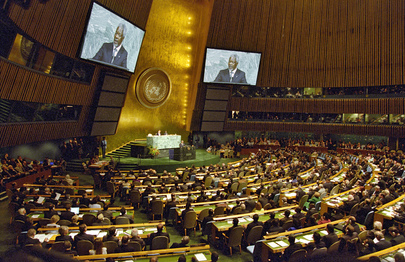
UN chief, Red Cross renew call for rules on autonomous weapons
As unconfirmed reports indicate that fully autonomous and AI-guided drones are in use on the battlefield, the UN and the Red Cross joined forces on Tuesday renewed their urgent call for stricter global controls.
The timing of the appeal reflects growing concerns that increasingly sophisticated weapons are being deployed at ever greater speed and scale.
Disarmament experts say that even arms manufacturers want clarity on the legal issues at stake.
Here’s Mélanie Régimbal, Chief of the UN Office for Disarmament Affairs in Geneva:
“Autonomous weapon systems that can select and engage targets without human judgement and control raise profound concerns…The Secretary-General has long warned of the dangers posed by these systems, emphasizing that machines that can select or engage targets and take human lives without human control and judgement are politically unacceptable, morally repugnant and should be prohibited under international law.”
The UN and Red Cross want governments to move beyond discussions and begin negotiations on a legally binding instrument with clear prohibitions and restrictions.
The joint appeal comes ahead of the seventh Review Conference of the Convention on Certain Conventional Weapons, in November in Geneva.
This meeting represents the “clearest path available” for States to agree to move towards negotiations on a legally binding instrument, both organizations stressed.
Afghanistan nutrition emergency leaves 3.7 million suffering from wasting
To Afghanistan, where a staggering 3.7 million malnourished children now suffer from wasting, an entirely preventable condition that affects physical and mental growth.
In an alert on Tuesday, the UN Children’s Fund, UNICEF, warned that nearly four in 10 youngsters admitted to hospital with severe wasting and medical complications are babies under six months old.
UNICEF Representative in Afghanistan, Dr. Tajudeen Oyewale described meeting a nine-month-old acutely malnourished baby called Sagida.
“When Sagida was brought for admission to hospital, the doctors had little hope that she was going to survive. She weighed barely four kilogrammes. But after receiving therapeutic milk, nutrition services and support she is now stable…and Sagida is just one of the many children suffering from malnutrition in Afghanistan.”
A total of one million children across Afghanistan now suffer from life-threatening severe acute malnutrition.
In parts of southern Afghanistan, some hospitals now have three or four severely malnourished children in every available bed.
New research from UNICEF revealed that families are cutting back on nutritious foods and children eat fewer different types of food. Meals become smaller and meals are skipped.
“When children reach six months of age and should begin receiving nutritious complementary foods alongside breastmilk, the reality for many families is (that) a child’s first foods may consist of little more than bread with tea or watered-down yoghurt,” the agency said.
UNICEF’s nutrition programme in Afghanistan requires around $180 million this year. It is only 22 per cent funded.
Red Sea pirates: Release all captive seafarers immediately, insists IMO chief
In other news, the head of the UN maritime organization, Arsenio Dominguez, has issued a demand for the immediate release of more than 90 seafarers held captive by pirates in the Gulf of Aden.
Six vessels have now been hijacked by pirates and armed robbers in waters “that are becoming too dangerous for seafarers”, said Mr. Dominguez, Secretary-General of the International Maritime Organization, or IMO.
The captive seafarers are subject to “constant uncertainty and threats” and they have limited access to adequate food, fresh water and medical support, the agency’s spokesperson, Josephine Latu-Sanft, told UN News:
“Behind each of them is a family enduring an unimaginable ordeal, with limited reliable information about their loved ones’ well-being. No seafarer should face violence, intimidation or exploitation simply for doing their jobs and keeping global trade moving.”
The UN maritime agency highlighted the deteriorating security situation and called for sustained international naval cooperation, which it insisted is essential to protecting merchant shipping and seafarers.
Daniel Johnson, UN News
Source of original article: United Nations (news.un.org). Photo credit: UN. The content of this article does not necessarily reflect the views or opinion of Global Diaspora News (www.globaldiasporanews.com).
To submit your press release: (https://www.globaldiasporanews.com/pr).
To advertise on Global Diaspora News: (www.globaldiasporanews.com/ads).
Sign up to Global Diaspora News newsletter (https://www.globaldiasporanews.com/newsletter/) to start receiving updates and opportunities directly in your email inbox for free.