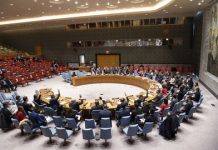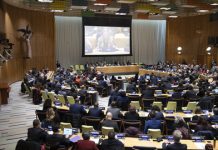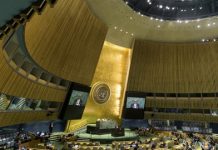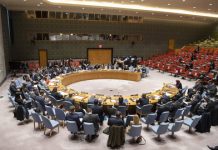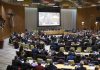

The two-day summit brings together ministers, chiefs of police and senior representatives of policing organizations to discuss how UN policing and national police can mutually reinforce one another in addressing current and emerging global security challenges.
“The goal of this summit is to ensure that our Organization is aligned and prepared to support the nearly 4,500 UN Police personnel nearly 80 countries who serve across our peace operations while also helping shape how United Nations policing continues to evolve to meet today’s increasingly complex security environment,” said chief of UN Peace Operations Jean-Pierre Lacroix.
“Ultimately, the focus is on ensuring that we continue to invest in peace by investing in effective policing, strong partnerships and the women and men who serve on the front lines every single day,” he said.
Budget cut impacts
Mr. Lacroix said recent budget cuts from the lack of some Member States fully paying assessed contributions “have had a real impact across the board where it matters most”.
“The approved budgets remain in place, but without the necessary cash, those budgets cannot be fully implemented,” he said. “We have effectively had to reduce spending by around 25 per cent, and this affects nearly every aspect of our work.”
Less payments mean reduced patrols in high-risk areas, longer response times to developing crises and fewer opportunities to train and support local police so they can assume full responsibility when missions eventually wind down.
A UN police officer interacts with women at a water point in Nifasha camp for internally displaced persons in north Darfur. (file)
Tackling cybercrime to sexual violence
Despite financial challenges, policing remains a cornerstone of sustainable peace, said UN Police Adviser Faisal Shahkar.
Unlike military peacekeepers, UN police work directly with communities to strengthen national police services, rebuild public trust and reinforce criminal justice institutions after conflict, tackling challenges from organised crime and cybercrime to sexual and gender-based violence.
The results are visible across peace missions:
- In the Democratic Republic of the Congo, UN police support civilian protection through integrated patrols, turning emergency calls into operational interventions and supporting national police in high-risk areas
- In the Central African Republic, UN police have helped national authorities prepare for safe and secure elections
- In Abyei, community-oriented policing, mediation and dialogue have helped reduce tensions between communities and promote women’s participation in local security arrangements
Beyond silenced weapons
Mr. Shahkar said this year’s summit will focus on the future of UN policing, including innovation and new technologies, stronger partnerships and more effective responses to transnational threats.
“For communities affected by conflict, peace is not only the silence of weapons. It is also the ability to return home, send children to school, report violence, access justice, and trust the institutions meant to protect them,” he said,
“At the heart of this summit is a simple message: safety is integral to peace.”
Live from New York’s Hudson River
Side events are running parallel to the summit, covering current issues facing communities around the world.
This one, sponsored by INTERPOL and UN agencies, focuses on protecting cultural heritage in peace operations.
Catch the live broadcast aboard an Italian vessel in New York’s Hudson River Park starting at 3pm local time on UN Web TV:
Demands for UN policing
Deployed for the first time to the UN Operation in the Congo (ONUC) in 1960, UN Police personnel at the time helped peacekeepers at the request of the newly independent Republic of the Congo, a former Belgian colony, after Belgium sent troops without the government’s agreement to quell post-independence disorder.
Since 1948, there have been 321 deaths of UN Police personnel.
Growing demands over the decades have led to deployments to many UN peacekeeping missions in hotspots around the world, from Cambodia to El Salvador, with the peak demand arriving in 2010, with 14,669 police deployed.
Learn more about the UN Police history here.
How can you become a UN Police officer?
Watch below:
Source of original article: United Nations (news.un.org). Photo credit: UN. The content of this article does not necessarily reflect the views or opinion of Global Diaspora News (www.GlobalDiasporaNews.com).
To submit your press release: (https://www.GlobalDiasporaNews.com/pr).
To advertise on Global Diaspora News: (www.GlobalDiasporaNews.com/ads).
Sign up to Global Diaspora News newsletter (https://www.GlobalDiasporaNews.com/newsletter/) to start receiving updates and opportunities directly in your email inbox for free.