

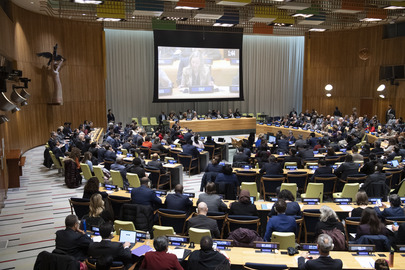
The study, Crime and Justice in a Changing World, by the UN Interregional Crime and Justice Research Institute (UNICRI), was presented on Wednesday at the 15th UN Congress on Crime Prevention and Criminal Justice in Abu Dhabi.
Drawing on nine regional studies, it finds that homicides fell from 5.9 per 100,000 people in 2015 to 5.2 in 2023 and are projected to decrease by 25 per cent between 2015 and 2030 under current trends.
Regional disparities
However, rates remain high in Latin America and the Caribbean and sub-Saharan Africa – which together account for roughly two thirds of all homicide victims worldwide – and are frequently driven by organised crime, gangs and transnational criminal groups.
The report says the two trends are not contradictory but reflect a shift in where criminal profit is generated: away from localised predation and towards transnational markets, digital victimisation and the exploitation of licit trade and supply chains.
Criminal networks are increasingly intertwined with legitimate economies, the report finds.
In Latin America, cartels that began in drug trafficking have expanded into agriculture, mining, fishing and wildlife, while Europol has assessed that nearly one fifth of criminal networks in Europe operate across multiple criminal markets.
In parts of Cambodia, Laos and Myanmar, criminal groups operating from special economic zones traffic thousands of people and run cyberfraud schemes, including romance-investment fraud and crypto scams.
Check our UN News stories and original reporting on Asia’s ‘scam farms’ here
In Cambodia, estimates of illicit proceeds from cybercrime and illegal gambling range from $12.5 billion to $19 billion a year – as much as 60 per cent of the Gross Domestic Product (GDP).
Technology has lowered the barriers to entry, with generative AI and “cybercrime-as-a-service” models meaning criminal capability no longer necessarily depends on organisational sophistication.
A 2025 survey of 42 countries cited in the report found that 57 per cent of adults worldwide had experienced a scam and 23 per cent had lost money in the previous 12 months.
Tougher responses
Justice systems are responding under considerable strain, the report says, with many increasingly shaped by concerns around security and State control rather than the rule of law and human rights.
It points to militarised policing, more punitive approaches to prisons and the lowering of the minimum age of criminal responsibility in parts of Oceania, East Asia and Latin America – often in tension with evidence on what reduces crime.
Meanwhile, States are adopting surveillance and AI technologies faster than the rules needed to govern them.
The report also highlights successes, noting that Brazilian megacity São Paulo’s sustained decline in homicides since the early 2000s has been linked to data-driven policing, firearms restrictions and municipal prevention measures.
Five avenues
The study suggests five areas for further research, engagement and transregional coordination:
- how emerging criminal models spread from one region to another
- when and where different kinds of crime overlap and feed each other
- long term effects on crime levels and what happens to trust in institutions
- effects of increasingly transactional cooperation, versus lasting partnerships
- how a multipolar world changes the way institutions work
Source of original article: United Nations (news.un.org). Photo credit: UN. The content of this article does not necessarily reflect the views or opinion of Global Diaspora News (www.globaldiasporanews.net).
To submit your press release: (https://www.globaldiasporanews.com/pr).
To advertise on Global Diaspora News: (www.globaldiasporanews.com/ads).
Sign up to Global Diaspora News newsletter (https://www.globaldiasporanews.com/newsletter/) to start receiving updates and opportunities directly in your email inbox for free.