
Concerns persist over toxic chemical spraying reports on Lebanon’s Blue Line
The UN reiterated concerns on Friday at reports that the Israel Defense Forces sprayed a toxic herbicide over areas north of the Blue Line separating Lebanon from Israel on 1 February.
In Geneva, the UN human rights office said that the development posed a “serious humanitarian risk” to civilians living there. It has called for further investigations to confirm what chemical substances had been used.
Alessandra Vellucci, head of the UN Information Service in Geneva, said that the UN peacekeeping mission in Lebanon, UNIFIL, remains in contact with the Lebanese authorities about the incident:
“The use of herbicides raises questions about the effects on local agricultural lands and how this might impact the return of civilians to their homes and livelihoods in the long term…We remind the parties of their obligations under international humanitarian law and other possible legal frameworks. Any activity by the IDF north of the Blue Line is a violation of Resolution 1701.”
Reports attributed to the Lebanese authorities indicate that the herbicide is glyphosate and that samples taken from the sprayed areas where there is dense vegetation showed concentrations at 20 to 30 times the recommended level.
Israeli settlement expansion risks viability of Palestinian state, warns UN human rights office
To the occupied West Bank, where chances of a viable Palestinian state risk being undermined by the rapidly expanding number of illegal Israeli settlements, the UN human rights office, OHCHR, has warned.
Since last year, tens of thousands of Palestinians have been forcibly displaced across the occupied West Bank, said OHCHR spokesperson Thameen Al-Kheetan:
“Relentless violence by Israeli settlers – with the support and participation of Israeli security forces, as well as movement restrictions are accelerating the forcible transfer of Palestinians…Further expansion of settlements will only entrench the racial segregation against the Palestinian people.”
Palestinians impacted by settler expansion include more than 32,000 people uprooted from three refugee camps as part of Israel’s “Iron Wall” operation in the camps of Jenin, Tulkarem and Nur Shams.
This is in addition to the “relentless violence” Palestinians face from settlers, “with the support and participation of Israeli security forces”, Mr. Al-Kheetan maintained.
After New START ends, new nuclear threats under spotlight at UN disarmament talks
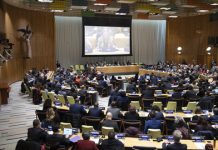
High-level talks on disarmament continued at the UN in Geneva on Friday where Member States discussed the increasing threat of a nuclear arms race among governments seeking to expand production of weapons of mass destruction.
The development comes a day after a key non-proliferation treaty called “New START” ended between the United States and Russia.
The agreement placed binding limits on the strategic nuclear arsenals of Russia and the U.S. but it is no longer fit for purpose, said U.S. Under Secretary of State for Arms Control and International Security, Thomas Dinanno:
“New START was signed in 2010 and its limits on warheads and launchers are no longer relevant in 2026 when one nuclear power is expanding its arsenal at a scale and pace not seen in over half a century and another continues to maintain and develop a vast range of nuclear systems unconstrained by New START’s terms.”
In response, Russia highlighted that the country had suspended its participation in New START in February 2023, in part because of “clear assistance” from Western countries to Ukraine in striking Russian facilities, but also in light of Washington’s allegedly “accelerated development of missile defence capabilities”.
Also present at the disarmament talks, China rejected what it called continuing U.S. statements attempting to “hype up” China’s nuclear threat.
China follows a “defensive nuclear strategy and a policy of “no first use” and has always kept its nuclear capabilities at the minimum level required for national security, the country’s delegation said.
The Conference on Disarmament in Geneva is the world’s sole multilateral disarmament negotiating forum.
Its efforts to pursue global controls on nuclear missiles and other weapons continue at its current session ending on 27 March.
Daniel Johnson, UN News
Source of original article: United Nations (news.un.org). Photo credit: UN. The content of this article does not necessarily reflect the views or opinion of Global Diaspora News (www.globaldiasporanews.com).
To submit your press release: (https://www.globaldiasporanews.com/pr).
To advertise on Global Diaspora News: (www.globaldiasporanews.com/ads).
Sign up to Global Diaspora News newsletter (https://www.globaldiasporanews.com/newsletter/) to start receiving updates and opportunities directly in your email inbox for free.