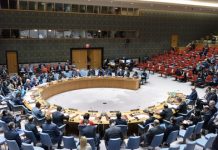

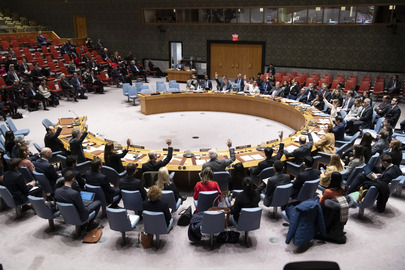
“In the last week alone, we witnessed one of the largest aerial bombardments of Ukraine since the Russian Federation’s full-scale invasion in February 2022,” said Director Kayoko Gotoh of the Political and Peacebuilding Affairs department.
Between 13 and 14 May, Russia reportedly launched more than 1,500 drones and dozens of missiles targeting cities across Ukraine.
Civilians face daily attacks
The deadliest incident occurred on 14 May when a missile reportedly flattened a nine-story apartment block in the capital, Kyiv, killing 24 people and injuring at least 48 others.
“These large-scale attacks have continued daily,” she said, noting that at least 238 civilians were killed, and 1,404 injured, last month alone.
“This represents the highest monthly number of civilian casualties recorded since July 2025,” she said. “It also reflects a continuing pattern of rising civilian harm.”
Ukrainian strikes inside Russia have also led to increasing civilian casualties and damage to civilian infrastructure.
Four people were reportedly killed this past Sunday in strikes across Russia, including the capital Moscow, while an attack on 15 May reportedly killed four people in Ryazan.
“We strongly condemn all attacks against civilian and civilian infrastructure, wherever they occur,” she said.
A UN vehicle severely damaged by two drone strikes while delivering supplies to civilians living in Ostriv, one of Kherson’s hardest hit areas.
Humanitarians under fire
Ms. Gotoh reported that UN personnel were involved in two “alarming drone-related incidents” last week – an issue that was further addressed by a senior official with the UN humanitarian affairs office, OCHA.
Edem Wosornu, Director of OCHA’s Crisis Response Division, said “two separate convoys, clearly marked as being part of the United Nations” were hit on 12 and 14 May.
“These brazen incidents are not isolated. In the same week, other humanitarian missions were hit, injuring humanitarian workers and damaging assets,” she said.
‘Attacks are intensifying’
Moreover, three humanitarian workers were killed, and 10 injured, during the first four months of the year.
“These attacks are intensifying, making the delivery of humanitarian assistance increasingly difficult, if not impossible in some areas,” said Ms. Wosornu.
“Humanitarian workers in Ukraine are taking immense risks to save lives. However, the weapons being deployed – cheap and deadly – are rapidly changing what it means to deliver life-saving assistance.”
Despite the dangers, the UN and partners continue to deliver aid where access allows yet needs continue to grow and a $2.3 billion plan for Ukraine has received some $845 million to date.
She urged Council members to ensure that international humanitarian law is respected, and to provide timely funding for humanitarian operations.
Temporary truce and prisoner exchange
Ms. Gotoh noted that amid the rising devastation and loss of life in Ukraine, the UN Secretary-General welcomed the announcement of the three-day ceasefire between Kyiv and Moscow, from 9-11 May, which was facilitated by the United States.
“However, we regret reported violations on both sides throughout the brief truce, mainly along and near the frontline,” she said.
“We are also deeply disturbed by the escalation of attacks by the Russian Federation almost immediately following the expiry of the ceasefire.”
The Secretary-General also welcomed announcement of an agreed exchange of 2,000 prisoners of war. The first step occurred on 15 May with the sides returning 205 prisoners each.
Concern for deported Ukrainian children
Meanwhile, the UN remains concerned about the fate of children who were deported and forcibly transferred from Ukraine whose “prompt and safe return will require consistent engagement by both sides.”
Before concluding her briefing, Ms. Gotoh recalled that a year has passed since direct negotiations between Ukraine and Russia resumed.
“Although direct talks, which are currently paused, have yet to result in a breakthrough, diplomacy has made it possible for thousands of prisoners of war to return home, and for remains of fallen soldiers to be laid to rest,” she said.
“Negotiations should resume without further delays to prevent further escalation and to make meaningful progress towards a full, immediate and unconditional ceasefire.”
Source of original article: United Nations (news.un.org). Photo credit: UN. The content of this article does not necessarily reflect the views or opinion of Global Diaspora News (www.globaldiasporanews.net).
To submit your press release: (https://www.globaldiasporanews.com/pr).
To advertise on Global Diaspora News: (www.globaldiasporanews.com/ads).
Sign up to Global Diaspora News newsletter (https://www.globaldiasporanews.com/newsletter/) to start receiving updates and opportunities directly in your email inbox for free.