
Armed gangs continue to perpetrate widespread violence in the Caribbean state, where they regularly murder, rape and kidnap civilians.
Around 6.4 million people require humanitarian assistance in the country and almost 1.5 million have been displaced.
The gangs now control large parts of the capital, Port-au-Prince, and key transport corridors, hampering the transport of essential services and humanitarian assistance.
More support from outside
“Haiti’s security […] depends on our collective ability to combat the illicit flows that fuel violence: weapons, ammunition, trafficking, and transnational criminal networks,” explained Mr. Fils-Aimé, as gangs source most of their weapons outside of Haiti.
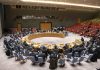
Speakers at the meeting, including the Haitian Prime Minister and UN officials, also expressed broad support for extending the mandate of a UN Security Council-backed force, the Gang Suppression Force (GSF).
The Gang Suppression Force is based at Camp Vertières in Port-au-Prince, the Haitian capital.
The force aims to neutralise armed gangs, protect vital infrastructure, and allow humanitarian aid to enter.
The mission is severely under-deployed, though, with only 1,083 personnel on the ground instead of the 5,500 that were authorised by the UN, highlighted the Special Representative of the Secretary-General for Haiti, Carlos Ruiz Massieu.
He called for the mission to reach full deployment as early as possible.
Strengthening Haitian capabilities
At the same time, while expressing their thanks to their international community for its support, representatives of Haiti stressed that they wanted a Haiti-centric response to the crisis to ensure a more sustainable peace.
“Haiti must ultimately rest on the capabilities of the Haitian state,” said the Prime Minister of Haiti, Mr. Fils-Aimé.
Importantly, he insisted that security operations are only a first step in tackling the crisis.
“The real test is whether we can hold those gains and translate them into lasting change for the Haitian population,” the Prime Minister said. “When an area becomes accessible again, the State and basic services need to follow: police and local authorities, but also schools, justice institutions and economic activity.”
In this vein, he shared that Haiti is strengthening its security forces by training and recruiting more police officers and soldiers.
He also said that two specialised Haitian judicial units are helping fight against impunity, financial crime, mass atrocity, crimes, and sexual violence.
Children at the forefront
A key priority raised at the meeting was ensuring that children, including those recruited or associated with gangs, receive adequate protection and support.
“Protecting children from violence, from gang recruitment, while providing safe pathways for children associated with armed groups, must be a priority across our efforts,” stressed Amar Bendjama, the President of the UN Economic and Social Council (ECOSOC) which hosted the meeting.
“They need access to protection, to education, to essential services. They also need opportunities to build for themselves a safe and secure future.”
The priority to protect children should guide efforts to dismantle gangs and hold those responsible for serious crimes accountable with Mr. Ruiz Massieu, the UN’s most senior official in Haiti, calling for “differentiated pathways” for children associated with gangs.
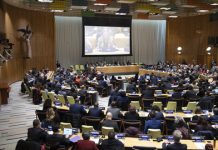
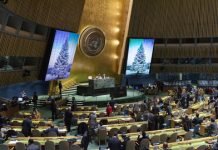
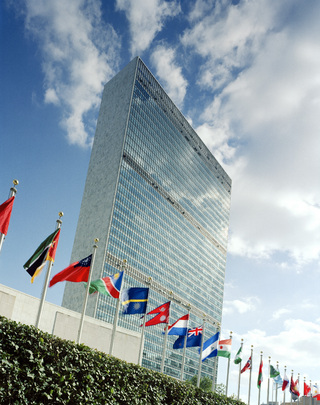
Haitian Prime Minister Alix Didier Fils-Aimé addresses a meeting on Haiti at UN Headquarters in New York.
Upcoming elections
General elections, which have been repeatedly delayed since 2019, are scheduled to be held in Haiti on 13 December 2026.
The UN and others expressed strong support for them, stressing that they should be credible, free, fair and inclusive.
The Haitian Primer Minister also expressed enthusiasm: “Haiti’s next government must come through the ballot box […] Voting restores legitimacy, and legitimacy paves the way for stability.”
“Today, the electoral process is well underway. Electoral operations have been launched. Citizens are registering. Political organizations have also been certified,” he explained.
Source of original article: United Nations (news.un.org). Photo credit: UN. The content of this article does not necessarily reflect the views or opinion of Global Diaspora News (www.globaldiasporanews.com).
To submit your press release: (https://www.globaldiasporanews.com/pr).
To advertise on Global Diaspora News: (www.globaldiasporanews.com/ads).
Sign up to Global Diaspora News newsletter (https://www.globaldiasporanews.com/newsletter/) to start receiving updates and opportunities directly in your email inbox for free.