
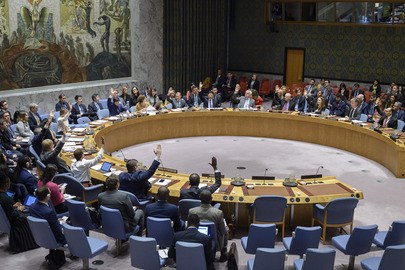
Delivering their latest update, the members of the UN Commission of Inquiry on Syria commended the Government and people for significant achievements made since the fall of the Assad regime nearly two years ago, including establishing a legislative body and constitutional court.
Difficult test
They noted the inherent difficulties in building institutions that respect human rights while simultaneously addressing the legacy of past atrocities and ensuring non-recurrence.
The independent investigators’ mandate from the council is to investigate all alleged violations of international human rights law since March 2011, when the country’s brutal civil conflict ignited during the years of the Assad dictatorship.
“Comprehensively addressing not only past but also recent violence is an essential step for reconciliation,” said Commissioner Monia Ammar, pointing to violence on the coast and western Syria in early 2025, in Sweida in July 2025, and following hostilities in January with the Kurdish-backed Syrian Democratic Forces (SDF).
“Many hundreds of people are still reported missing,” she added.
Syria’s transition follows more than a decade of civil war and systematic abuses. The investigators welcomed ongoing engagement with the authorities but cautioned that the limited number of trials so far are insufficient to bring justice.
They highlighted the significant human rights challenges facing the country, notably those resulting from Israeli military activity, insufficient accountability, fragile civic space, the political and economic legacy of conflict, gender-based harms, continued instability in Sweida and the post-conflict situation including detention in the northeast.
Other concerns included reported deaths in detention, arrests of activists, persistent hate speech and online harassment, as well as threats of violence against women, with particular focus on women activists.
Israeli military presence
The independent investigators said Israeli military activity on Syrian territory “is increasingly sustained and entrenched”. Operations include ground incursions, patrols, raids and searches which have sparked displacement.
As of September, Israeli forces have detained 49 people, including two children inside Syria, some of whom are being held incommunicado.
“We are deeply alarmed by violations of human rights and international humanitarian law by Israel on Syrian territory, which may amount to war crimes,” said Commissioner Fionnuala Ní Aoláin.
Notorious detention camps
The briefing also addressed the situation in northeast Syria. The Commission is investigating alleged violations during January hostilities involving the SDF and Government forces, including reported killings of detainees.
The worsening condition at detention camps holding people who have alleged ties to ISIL, also known as Da’esh, was also addressed.
The Commission again called for the immediate closure of the Al Rawj camp – home to more than 2,000 people, mostly women and children – and for all foreign nationals there to be repatriated.
More than 100 foreign children remain detained in the northeast, some of whom have been held since 2019.
The Commission also voiced deep concern over the “mass forcible transfer” earlier this year of more than 5,700 men and boys to Iraq by United States forces. The group reportedly represented more than 60 nationalities, including Syrians.
International support critical
In conclusion, the Commission said the UN Human Rights Council and the international community have a vital role in supporting Syria’s efforts to cement respect for human rights.
“Syria can fulfill the aspirations of its people if it manages to break the legacies of past violence and advances solid foundations to prevent recurrence based on respect for fundamental human rights,” said Ms. Ammar, underlining commitment to support the country through its transition.
The Independent International Commission of Inquiry on the Syrian Arab Republic was appointed by the President of the UN Human Rights Council following unrest that began in March 2011, leading to more than a decade of war.
The independent commissioners are not UN staff and do not receive a salary for their work.
Source of original article: United Nations (news.un.org). Photo credit: UN. The content of this article does not necessarily reflect the views or opinion of Global Diaspora News (www.globaldiasporanews.net).
To submit your press release: (https://www.globaldiasporanews.com/pr).
To advertise on Global Diaspora News: (www.globaldiasporanews.com/ads).
Sign up to Global Diaspora News newsletter (https://www.globaldiasporanews.com/newsletter/) to start receiving updates and opportunities directly in your email inbox for free.