
The West African country has increased domestic revenue by 0.5 per cent of GDP each year for the past decade, issued Africa’s first SDG bond in 2021 and used the resulting funding to expand access to education and drinking water, Aristide Medenou, Benin’s minister of economic cooperation, said on Friday.
Access to drinking water there has increased from 40 per cent to 80 per cent in the past five years, Mr. Medenou said, while a new industrial zone launched in 2021 has created 25,000 jobs.
“If a country is not able to increase the domestic revenue, the country cannot go forward in implementing the SDGs,” Mr. Medenou said at the UN’s annual SDG Moment event ahead of the General Assembly’s High-Level Week in New York.
Even as the world remains far from achieving the SDGs, Mr. Medenou said Benin offers a concrete example of governments translating commitments into beneficial policies.
Many goals off track
In 2015, all UN Member States adopted the 2030 Agenda for Sustainable Development, committing to 17 SDGs focusing on issues such as ending poverty, protecting the planet and ensuring lasting peace.
Member States set a target to achieve these goals by 2030. However, the UN’s most recent progress report indicated that progress on the goals is slow and uneven – of the 139 targets with available trend data, 36 per cent are on track or making moderate progress.
“Progress was never automatic,” UN Secretary-General António Guterres said on Friday. “It was earned through the determination of people, communities and countries.”
SDGs create meaningful progress
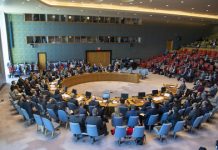
At UN Headquarters in New York, UN officials and world leaders highlighted both the gains made over the past decade – and the scale of the remaining challenge.
Nearly a billion people have gained access to safely managed drinking water since the SDGs were adopted, and 1.2 billion have gained access to safely managed sanitation. Electricity now reaches 92 per cent of the world’s population – up from 87 per cent in 2015 – and internet access has risen from 40 per cent to 74 per cent.
But 49 per cent of SDG targets with available trend data are progressing too slowly, while 15 per cent have fallen below their 2015 baselines, according to the SDG Progress Report.
Food insecurity affected 2.1 billion people in 2025, while one in 10 people still live in extreme poverty, said General Assembly President Khalilur Rahman.
The world faces a $4 trillion annual SDG financing gap, while official development assistance fell by a record 23 per cent in 2025. In many countries, debt payments outstrip spending on social services.
The world is currently on track to warm by around 2.8 degrees Celsius this century, well above the 1.5-degree threshold set by the Paris Agreement.
“These are losses that many cannot absorb,” Mr. Rahman said. “For many of us, sustainability is a matter of life and death.”
Suzuka Nakamura (left), Young Leader for the SDGs from Japan, and Adelin Pierre, Young Leader for the SDGs from Haiti, speaks during the SDG Moment 2026.
Young leaders call for action
Suzuka Nakamura of Japan and Adelin Pierre of Haiti, two of the UN’s Young Leaders for the SDGs, called on governments to act with the same urgency that led them to agree on the SDGs 11 years ago.
“To the leaders in this room and around the world, you made this promise,” Ms. Nakamura said. “We are asking you to keep it.”
Mr. Medenou also stressed the need to involve the private sector, saying governments “cannot do it alone.”
‘Powerful headwinds’ to SDG progress
Mr. Guterres said the lives that have been improved by SDG implementation demonstrate that multilateral cooperation can produce tangible improvements when governments act.
He explained that the pursuit of the goals has helped reduce child and maternal mortality, prevent millions of new HIV infections, and expand access to education, social protection, renewable energy and other services.
But progress faces “powerful headwinds” such as conflicts, weakened international cooperation, the climate crisis, attacks on the rights of women and girls, and debt and investment constraints, Mr. Guterres said.
“The promises governments made in adopting the Goals are not being kept,” he said. “It is time to keep them.”
Peace a prerequisite
The Secretary-General emphasised the priorities of fighting inequality, protecting the planet, financing sustainable development and using all available tools and technologies to accelerate progress.
He called for greater investment in education and health, a just transition to renewable energy, stronger financing and debt support for developing countries, and greater use of technology such as “responsible” artificial intelligence.
Mr. Guterres said peace is both a foundation and an enabler of sustainable development, stressing that the world needs renewed efforts to secure peace everywhere.
There’s still time
With four years until the deadline, speakers emphasised the need to convert commitments into results while reaching the people who remain the furthest behind.
UN Economic and Social Council (ECOSOC) President Amar Bendjama said progress is possible when ambition is matched with implementation.
For the young leaders at the event, the impending deadline is not a reason to abandon the goals, but a reason to act with increased urgency.
“There is still time to act, but we need to move together,” Ms. Nakamura said. “We are not giving up hope on the SDGs, and neither should you.”
Source of original article: United Nations (news.un.org). Photo credit: UN. The content of this article does not necessarily reflect the views or opinion of Global Diaspora News (www.globaldiasporanews.com).
To submit your press release: (https://www.globaldiasporanews.com/pr).
To advertise on Global Diaspora News: (www.globaldiasporanews.com/ads).
Sign up to Global Diaspora News newsletter (https://www.globaldiasporanews.com/newsletter/) to start receiving updates and opportunities directly in your email inbox for free.