
Richard Gowan, Director of UN and Multilateral Diplomacy at the International Crisis Group in New York, has spent years studying the organization – its highs and lows.
Ahead of the General Assembly’s high-level week, he sat down with UN News to discuss why the Assembly remains a vital stage for international diplomacy – and why, despite a changing world rife with division, its role still matters.
UN News: Take us back to 1945, when the UN was created in the aftermath of the Second World War. What did its founders hope the General Assembly would become?
Richard Gowan: I think the founders of the UN assumed that the Security Council would be the centre of most decision making in 1945. But after the UN started working, the big powers in the Security Council became divided very quickly, and suddenly a lot of political discussions moved to the General Assembly.
If you go back to the 1940s and early 1950s, it was the General Assembly that was really driving a lot of decisions around the Palestinian question, around Korea, rather than the Security Council, which was very frequently paralyzed by Cold War tensions.
The first session of the UN General Assembly opened on 10 January 1946 at Central Hall in London, United Kingdom. (file)
UN News: As tensions grew between the United States and the Soviet Union, how did the General Assembly function in an increasingly divided world?
Richard Gowan: If you go back to the 1940s and 1950s, most countries in the General Assembly were friends and allies of the United States, so when the Security Council was gridlocked between the US and the Soviet Union, often the US would turn to the General Assembly for support.
When it became impossible to talk about the Korean War in the Security Council, the General Assembly led discussions around what to do with Korea.
The big test for the General Assembly came in 1956, when there were two crises simultaneously, one over Suez, where Britain and France had intervened, and one over the Soviet invasion of Hungary. That was an incredibly dramatic time, and it was the Assembly that mandated the very first [military] UN peacekeeping operation to help end the Suez crisis, which was one of its biggest contributions to crisis management throughout the Cold War.
An Austrian army captain stands at an observation post near the Suez Canal. (1979)
UN News: As newly independent states joined the United Nations during the 1960s, how did expanded membership transform the General Assembly, its priorities and debates?
Richard Gowan: The way the General Assembly grew during the 1960s was not something that the founders of the UN had envisaged. I think they believed that the maximum size of the General Assembly might be 80 or 90 countries.
The General Assembly was a place where newly free countries could make their voices heard. And in the 1960’s, we start to see the General Assembly focus on one issue that was especially important to many former colonies – apartheid in South Africa.
And throughout the 1960s, the General Assembly passes a series of resolutions condemning apartheid. And then eventually in the 1970s, the General Assembly suspends apartheid South Africa’s membership altogether, and that was a sign of how what we now call the Global South, was really emerging as a force in the General Assembly.
Jesse Jackson (left) speaks with the Joseph N. Garba, the Permanent Representative of Nigeria to the United Nations and the Chair of the Special Committee Against Apartheid. Rev. Jackson was visiting the UN to address the Special Committee.
UN News: As developing countries became more organized and influential in the General Assembly, how did they reshape the issues that the UN focused on?
Richard Gowan: Developing countries wanted to use the General Assembly as a space to talk about apartheid in South Africa, to talk some other late colonial crises, like the persistence of the Portuguese Empire in Africa; to talk about Palestine, which became more of a focus in the 1970s.
But developing countries also wanted to talk about what they saw as a very unfair global economic order. And in 1974, the General Assembly passed a resolution calling for a new economic order that would be fairer to the developing world. And that started some very tough diplomacy, that ran through the 1970s and the 1980s about the unfairness of the global economic system.
UN News: Do you feel like they changed global politics beyond the UN?
Richard Gowan: The General Assembly during the Cold War was the primary platform for countries emerging from colonialism to assert themselves on the world stage, and I do think that the campaign against apartheid in the General assembly did have a huge impact and did contribute to the eventual collapse of apartheid at the start of the 1990s.
I think without the assembly, the vast majority of UN Member States wouldn’t have had a voice on many global affairs. We didn’t get a new international economic order that would be fairer to the global south, but without the assembly, many countries would not really have had global voice at all.
Three speakers at the Decolonization Committee on Portuguese-Administered Territories. (1973)
UN News: The end of the Cold War brought new optimism about international cooperation. How did the assembly respond to this new era, and what opportunities emerged for the United Nations in particular?
Richard Gowan: The post-Cold War decades were a period where diplomats were partially able to put aside their ideological differences and talk much more constructively about how to strengthen the UN system.
During the Cold War, diplomats from the communist bloc literally wouldn’t talk to their counterparts from Western countries unless they absolutely had to.
There was this new spirit of communication, and cooperation, and you had ambassadors working with the UN Secretariat to develop new ideas that were passed through the General Assembly about how to develop new arms of the UN, like the Peace Building Commission, which was approved in 2005.
UN News: As globalization accelerated in the new millennium, the United Nations faced new economic, environmental and political challenges. Looking back at the 2000s, which debates or decisions do you think most shaped the General Assembly’s role?
Richard Gowan: I think there was a shock for the assembly with the global financial crisis in 2008 and 2009. A lot of UN members felt that the UN should be responding to the financial crisis.
But instead, the US and other major economies decided to work through the G20. And in that period, there was a lot of criticism from the countries of the Global South. But it is also worth keeping in mind that this was a period when we started to see much more discussion around the environment, around the need for efforts to protect the planet starting to come up through the General Assembly in addition to other UN forums.
UN News: If you were speaking to the founders in 1945, what do you think would surprise them most about the General Assembly today, and what advice might they have for its future?
Richard Gowan: We’ve got to remember that the key figures in the founding of the UN thought that it was a system that was going to sustain the old imperial order.
Instead, the UN, and especially the General Assembly, provided a framework for countries to come out of colonization, and then step onto the world stage, start speaking about global politics, and start challenging power.
The assembly played a central role in the history of decolonization, and I think that if you had told someone like Winston Churchill, who was there at the creation of the UN, they would have been very surprised to hear that that’s happened.
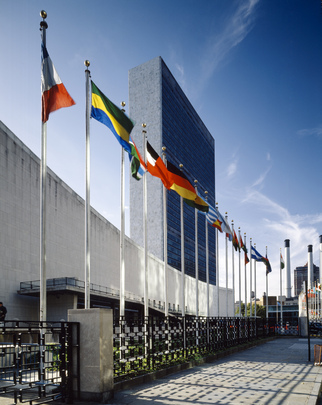
The UN Headquarters (centre left) as seen from across the East River in New York.
UN News: As an expert of the UN, what is the importance of keeping the UN in New York today?
Richard Gowan: We are at a moment in time where there’s a whole lot of diplomatic clubs out there – you have the G7, you have the BRICS, you have many different forums.
But we’ve got to remember that for a lot of small countries, and for a lot of middle powers, the General Assembly is still their main stage. It’s their main platform to talk about global affairs.
And although you often hear people saying that the UN is in decline, still every September we get record numbers of leaders coming to speak at the General Assembly.
It is still a stage that matters. And it’s also worth remembering that the place that the world goes to react to an urgent crisis, is the General Assembly.
There’s no alternative to that. You could move the General Assembly to another city, but I think that for many leaders around the world, there is something special about having this body here where they can make their voices heard at the centre of the global media scene and the global diplomatic scene.
Source of original article: United Nations (news.un.org). Photo credit: UN. The content of this article does not necessarily reflect the views or opinion of Global Diaspora News (www.globaldiasporanews.com).
To submit your press release: (https://www.globaldiasporanews.com/pr).
To advertise on Global Diaspora News: (www.globaldiasporanews.com/ads).
Sign up to Global Diaspora News newsletter (https://www.globaldiasporanews.com/newsletter/) to start receiving updates and opportunities directly in your email inbox for free.