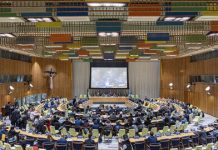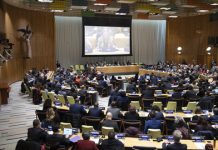

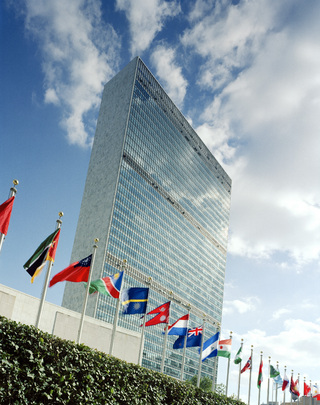
Meeting at UN Headquarters, in New York, from 2 to 10 February, the Commission for Social Development marked its first session since the Second World Summit for Social Development, held in Doha last year.
The gathering brought together ministers, senior UN officials, civil society groups and youth representatives to examine how global pledges can be translated into coordinated, inclusive and equitable policies at the national level.
Opening the session, Economic and Social Council (ECOSOC) President Lok Bahadur Thapa stressed that social development policies are where “resilience, social cohesion, and trust are ultimately tested.”
He warned that widening inequalities, demographic change, and rapid digital and green transitions are placing growing strain on societies worldwide. Responding in an integrated, people-centred way, he said, is “not merely a policy choice; it is a moral imperative.”
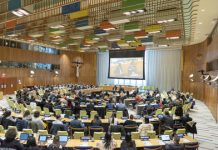
Delegates at the 64th session of the Commission for Social Development.
What is the Commission for Social Development?
The Commission for Social Development is an ECOSOC functional commission and the United Nations’ primary intergovernmental body for social development.
Established in 1946, it has helped shape global policy frameworks on poverty eradication, employment, social protection and inclusion, including by steering follow-up to landmark agreements such as the 1995 Copenhagen Declaration and, more recently, the 2025 Doha Political Declaration.
Click here for UN News special coverage of the Doha Summit
Over the years, the Commission has driven progress on universal social protection, decent work for all, and international focus on groups at risk of exclusion, including persons with disabilities, older persons, youth and families.
Its conclusions have informed national policies, helped develop social protection floors, and reinforced links between social development and the Sustainable Development Goals.
The Commission meets annually at UN Headquarters, in New York, generally in February.
Click here for more information on the Commission
A post-Doha moment for social policy
This year’s priority theme – advancing social development and social justice through coordinated, equitable and inclusive policies – framed discussions throughout the session, reflecting concerns that fragmented policymaking is slowing progress on poverty eradication, decent work and social inclusion.
Addressing delegates, General Assembly President Annalena Baerbock underscored that social development is not a secondary concern reserved for calmer times, but “the foundation that peace is built upon” and a critical investment in stability.
Ending hunger and poverty, she said, is both a moral obligation and a matter of security, noting how deprivation fuels conflict, migration and instability.
From commitments to delivery
In a message to the Commission, Deputy Secretary-General Amina Mohammed highlighted the shift signalled by the Doha Political Declaration away from incremental progress towards more ambitious, coordinated action.
She pointed to strong civil society engagement – with more than 700 non-governmental organizations (NGOs) registered for the session – and urged governments to match that readiness with concrete delivery.
“If Copenhagen, Doha and the 2030 Agenda are where we drew the map, then the Commission for Social Development sets us on the road,” she said.
Click here to watch the Deputy Secretary-General’s message
Coordinating policies in a changing world
Throughout the session, speakers repeatedly stressed the need for greater policy coherence – aligning employment strategies with universal social protection floors, inclusive education and health systems, and just-transition measures.
The Commission also examined emerging social challenges, including demographic change, labour-market disruption, and the social impacts of digital transformation and artificial intelligence.
Delegates heard that while new technologies carry risks, they can also accelerate progress towards the Sustainable Development Goals (SDGs) if governed inclusively and equitably.
A young boy relaxes in a wicker basket as his family threshes harvested wheat.
Youth mental health in focus
Youth voices featured prominently, reflecting the Commission’s emphasis on inclusion. The launch of the World Youth Report on Youth Mental Health and Well-being highlighted the growing pressures facing young people – from poverty and inequality to climate stress, conflict and digital harms.
Youth delegates and advocates shared lived experiences, describing how uncertainty about the future is eroding trust and well-being among younger generations, while calling for preventive, community-based and youth-responsive approaches.
Resolutions endorsed
At the close of the session, Member States endorsed two draft resolutions – one on advancing social development and social justice through coordinated, equitable and inclusive social policies, and another on the social dimensions of the New Partnership for Africa’s Development.
The resolutions reaffirm commitments made at the 1995 Copenhagen Summit and the 2025 Doha Summit, while emphasizing the need to translate global pledges into concrete national action.
Outcomes from the session will feed into upcoming UN processes, including the High-Level Political Forum on Sustainable Development in July, ECOSOC’s broader work, and the General Assembly’s five-year follow-up towards a high-level review of social development commitments in 2031.
Source of original article: United Nations (news.un.org). Photo credit: UN. The content of this article does not necessarily reflect the views or opinion of Global Diaspora News (www.globaldiasporanews.com).
To submit your press release: (https://www.globaldiasporanews.com/pr).
To advertise on Global Diaspora News: (www.globaldiasporanews.com/ads).
Sign up to Global Diaspora News newsletter (https://www.globaldiasporanews.com/newsletter/) to start receiving updates and opportunities directly in your email inbox for free.