
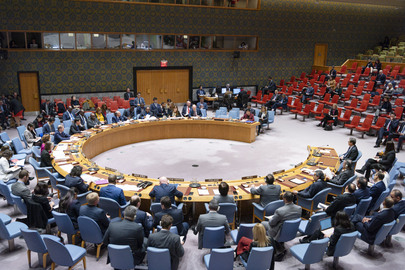
Calling Iran “the number one sponsor of terror,” the President devoted much of his speech to the Islamic Republic, arguing that his Administration had confronted a threat that previous leaders – in the US and abroad – had failed to address.
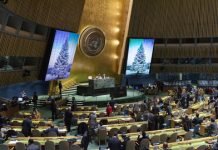
He told world leaders gathered in the Assembly Hall for the annual General Debate that for 51 years, “the fanatical Iranian regime” had spread “carnage and chaos” across the entire Middle East and beyond.
Nuclear weapons ban
“I will never allow Iran to have a nuclear weapon,” he said.
Mr. Trump said his administration had offered Iran economic cooperation in exchange for ending its nuclear programme and support for terrorism, but that Tehran had rejected the proposal.
“Then in Operation Midnight Hammer, the US military obliterated their nuclear programme beneath mountains of rubble,” he said.
The President went on to claim that subsequent military operations had severely weakened Iran’s military capabilities, citing the destruction of naval assets, air defences and missile production facilities.
“Will a deal be made with Iran that lets them rebuild and create a far greater country than it ever was before?” he asked.
But he also described a binary choice, over whether to “annihilate the Islamic Republic” and “drive them into hell with no chance of survival and no hope of future greatness.”
Mr. Trump predicted an agreement would eventually be reached. “I believe we’ll make a deal,” he said.
Calling for continued international unity, he urged countries to support the “complete economic isolation of Iran” until it ended attacks on commercial shipping and support for terrorism.
Wars settled, conflicts addressed
Turning to broader foreign policy, Mr. Trump said he had helped bring an end to eight conflicts since returning to office.
Among those he listed were disputes involving Cambodia and Thailand, Kosovo and Serbia, the Democratic Republic of the Congo (DRC) and Rwanda, Pakistan and India, Armenia and Azerbaijan, as well as the war in Gaza.
The President also said efforts were continuing to end the conflict between Russia and Ukraine.
“It’s time to stop the killing,” he said.
Pressure in the Americas
Mr. Trump highlighted a series of developments across the Western Hemisphere, including what he described as a US military operation in Venezuela that resulted in the arrest of President Nicolás Maduro.
He said the US was now working with Venezuelan leaders toward what he called “a much better future for the Venezuelan people” and announced a major oil agreement between the two countries.
On Mexico, the President focused on efforts against transnational crime, saying drug cartels had been designated as foreign terrorist organizations and calling on the country to “reclaim control of its soil from the enemies of humanity.”
He also cited ongoing negotiations with Cuba, saying his administration sought “a fundamental change in the situation” there.
The President also lauded the new agreement due to be signed with Greenland, describing the Arctic territory as strategically important to regional and international security.
Mr. Trump said the arrangement with Denmark and Greenland would give the United States “permanent control over security and all other needs” on the territory and would support NATO’s security posture in the Arctic and North Atlantic regions.
From AI to ‘superintelligence’
A significant portion of the address also focused on artificial intelligence (AI), which Mr. Trump argued should instead be called “superintelligence.”
“The use of the word artificial makes intelligence fake,” he said. “It is not fake. It’s actually amazing.”
President Trump said technological leadership would be central to economic and geopolitical competition in the years ahead.
“Whoever wins superintelligence wins,” he declared, adding that the US would encourage development of the technology while monitoring potential risks.
‘Evil people’
Mr. Trump also renewed criticism of several international bodies.
He described the International Criminal Court (ICC) as an institution “full of evil people” with no jurisdiction over the United States and called on nations to withdraw from it.
The President was similarly critical of the Geneva-based UN Human Rights Council, accusing it of focusing excessively on the US while overlooking abuses elsewhere.
He criticized the education, culture and science agency, UNESCO and the International Maritime Organization, arguing that international bodies should not advance what he characterized as global governance initiatives.
Concluding his address, Mr. Trump called on countries to confront global challenges with “courage and resolve,” saying cooperation among nations could create “a future for our people that is brighter, more hopeful, and more magnificent than ever before.”
Source of original article: United Nations (news.un.org). Photo credit: UN. The content of this article does not necessarily reflect the views or opinion of Global Diaspora News (www.globaldiasporanews.com).
To submit your press release: (https://www.globaldiasporanews.com/pr).
To advertise on Global Diaspora News: (www.globaldiasporanews.com/ads).
Sign up to Global Diaspora News newsletter (https://www.globaldiasporanews.com/newsletter/) to start receiving updates and opportunities directly in your email inbox for free.