
A new offensive by the Alliance Fleuve Congo/Mouvement du 23 mars (AFC/M23) has reignited large-scale hostilities in South Kivu, just days after international agreements were signed to de-escalate the conflict.
The renewed fighting has caused civilian casualties, destroyed infrastructure and driven hundreds of thousands from their homes, according to United Nations officials and humanitarian groups.
The UN and the Security Council have repeatedly described the majority-Tutsi M23 militia as backed by Rwanda – a claim Kigali has repeatedly denied.
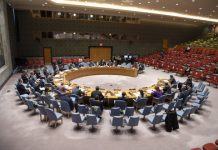
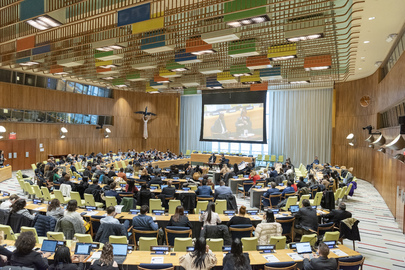
US Ambassador Mike Waltz told the Council on Friday that having brought Rwanda and DRC together in Washington to sign a peace agreement just last week, the Government was “incredibly disappointed” in Kigali’s actions in recent days in support of the M23 rebels which they fully control.
A crisis of ‘incalculable consequences’
Jean-Pierre Lacroix, head of UN Peace Operations, warned that the offensive has revived “the spectre of a regional flare-up with incalculable consequences,” saying the territorial expansion of AFC/M23 and the weakening of the DRC Government’s authority in eastern areas threaten national unity, sovereignty and territorial integrity.
He said recent diplomatic breakthroughs – including the Washington Accords signed on 4 December between DRC and Rwanda, and the Doha Framework Agreement in November between DRC and the AFC/M23 – had generated genuine hope for de-escalation.
But persistent ceasefire violations and renewed fighting now risk unravelling that progress.
“The growing gap between political commitments and their effective implementation on the ground undermines the credibility of peace processes and fuels the sense of abandonment felt by civilians,” Mr. Lacroix said.
MONUSCO peacekeepers on patrol near Bunia, the provincial capital of Ituri in eastern DR Congo.
MONUSCO, a critical lifeline
As violence escalates, the UN peacekeeping mission MONUSCO remains a central – and increasingly strained – pillar of civilian protection in eastern DRC, just days before the Security Council is set to decide on the renewal of its mandate.
Mr. Lacroix told Council members that MONUSCO continues to provide direct physical protection to around 100,000 displaced people living near its bases, particularly in North Kivu and Ituri, through daily patrols, early-warning systems and close engagement with communities.
He said the mission has adopted a more preventive posture, focusing on deterrence, rapid response and sustained presence around displacement sites where armed groups operate in close proximity.
Operations constrained
However, he cautioned that MONUSCO’s ability to carry out its mandate is being increasingly constrained. Restrictions imposed by AFC/M23 on freedom of movement, fuel supplies, water and electricity – along with the continued closure of Goma airport – are limiting mobility, delaying rotations and hampering humanitarian access.
At the same time, funding shortages and reductions in uniformed and civilian personnel, linked to the UN’s broader liquidity crisis, are affecting the mission’s rapid response capacity and operational reach.
Mr. Lacroix stressed MONUSCO’s role in protecting civilians and supporting de-escalation remains essential, warning that “diplomatic progress must now translate into real improvements on the ground.”
Dr. Javid Abdelmoneim of Médecins Sans Frontières, briefs the Security Council on health and humanitarian situation in eastern DR Congo.
Health system collapsing
The humanitarian toll is mounting. Hospitals and clinics across North and South Kivu are struggling to cope with a steady influx of wounded civilians amid acute shortages of staff, medicines and equipment.
Dr. Javid Abdelmoneim, emergency medicine doctor and international president of Médecins Sans Frontières (MSF), said health systems in eastern DRC are “collapsing” under the combined impact of violence, mass displacement and shrinking humanitarian access.
“MSF teams continue to witness staggering levels of violence, displacement and deprivation,” he said. “This crisis is not easing.”
Sexual violence and disease outbreaks
Sexual violence remains widespread and systematic, particularly affecting women and girls.
Dr. Abdelmoneim said nearly 28,000 survivors sought care at MSF-supported facilities across eastern DRC in the first six months of the year alone – an average of more than 150 people a day. Many arrived too late for preventive treatment, while others never reached care at all.
At the same time, infectious diseases are spreading rapidly. Cholera cases have surpassed 38,000 this year, with deaths more than doubling compared to last year. Measles continues to spread, and malaria outbreaks are unfolding amid limited diagnostic and treatment capacity.
DR Congo pursuing solutions in good faith
The Democratic Republic of the Congo condemned what it described as a renewed Rwanda Defence Forces-M23 offensive launched shortly after the Washington Accord was signed, saying it violated commitments and worsened an already grave humanitarian situation.
Foreign Minister Thérèse Kayikwamba Wagner said Kinshasa had pursued diplomacy in good faith through US-, Qatari- and African-led processes but warned that continued attacks, civilian targeting and cross-border risks threaten regional stability.
She urged the Security Council to enforce resolution 2773 (2025), strengthen MONUSCO’s mandate and impose consequences for continued violations, stressing that durable peace requires accountability.
Rwanda alleges persecution in South Kivu
Rwanda rejected the accusations and said the renewed MONUSCO mandate should reinforce the Washington Peace Agreement and Doha Framework through strict impartiality and support for ceasefire implementation.
Ambassador Karoli Martin Ngoga stated that progress depended on political will from all parties and raised concerns over what he described as persecution of the Banyamulenge community in South Kivu, citing displacement, killings and blockades by Congolese forces and allied militias.
He called for a political solution and reaffirmed Kigali’s stated commitment to advancing durable peace through the Washington process.
Burundi condemns capture of Uvira
Ambassador Zéphyrin Maniratanga of Burundi condemned the reported capture of Uvira by Rwanda Defence Forces-backed M23 fighters, calling it a violation of resolution 2773 and warning of severe civilian suffering and mass displacement into his country.
He said cross-border artillery and drone strikes had hit Burundian territory, threatening sovereignty and regional stability.
He called for the full implementation of the Washington commitments, stronger civilian protection and urgent humanitarian assistance for refugees, while reaffirming its readiness to support peace efforts and defend its territorial integrity under the UN Charter.
Source of original article: United Nations (news.un.org). Photo credit: UN. The content of this article does not necessarily reflect the views or opinion of Global Diaspora News (www.globaldiasporanews.net).
To submit your press release: (https://www.globaldiasporanews.com/pr).
To advertise on Global Diaspora News: (www.globaldiasporanews.com/ads).
Sign up to Global Diaspora News newsletter (https://www.globaldiasporanews.com/newsletter/) to start receiving updates and opportunities directly in your email inbox for free.