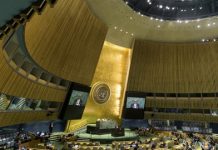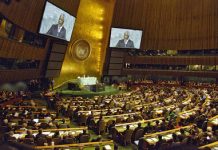

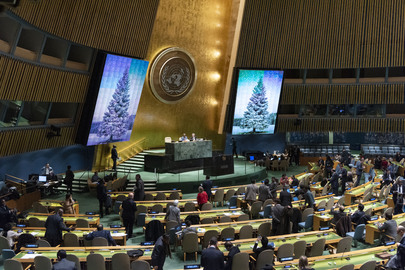
Addressing the general debate of the Assembly’s 81st session, Mr. Shah said the Bhotekoshi-Trishuli disaster four weeks earlier in northern Nepal had swept through mountain communities with a ferocity described as a “Himalayan Tsunami”.
More than 6,000 people remain missing and damage is estimated at around 10 per cent of Nepal’s gross domestic product (GDP).
“The Bhotekoshi-Trishuli disaster was not just a local tragedy, it was a warning to the world,” he said. “And I ask you today: have we really heard that warning?”
Climate justice
Mr. Shah said a warming climate was destabilizing the Himalayan ecosystem, with melting permafrost contributing to unstable mountain slopes and increasing the risks of avalanches, floods and landslides.
The devastation, he added, extended across Nepal’s border with China and downstream towards India.
“Climate change does not recognize borders. Glaciers and floods do not travel with a visa stamped on passports.”
Nepal contributes less than 0.1 per cent of global greenhouse-gas (GHG) emissions, he said, yet disasters repeatedly destroy infrastructure and livelihoods and force the country to borrow to rebuild.
“Climate Justice cannot just remain a beautiful phrase in a United Nations document,” he said.
The Prime Minister proposed a Himalayan Climate Resilience Mechanism led by Nepal, India and China to share satellite data and expertise, monitor dangerous glacial lakes, strengthen early-warning systems and coordinate cross-border disaster assistance.
He also called for greater grant-based climate financing, arguing that the Loss and Damage Fund, Global Environment Facility and other mechanisms remain “grossly inadequate”.
“When the house is burning, we do not ask the family to complete fifty forms. We act,” he said.
Broken logistics for food
Broadening his address, Mr. Shah noted that climate vulnerability was exposing deeper inequalities in the international system, where poorer countries face disruptions caused by conflicts and decisions beyond their control.
He contrasted shortages of fertilizer, fuel and road-building materials in Nepal with the speed at which weapons move around the world.
“We have built a world with flawless logistics for war and broken logistics for food,” he said.
Countries like Nepal face a similar predicament, he added: “hit by the climate we did not warm and hit again by the wars we did not start.”
Yet Mr. Shah said those failures strengthened rather than diminished Nepal’s commitment to multilateralism.
“This is why we continue to believe in multilateralism,” he said. “This is why we need a United Nations in which the presence of small poor countries is felt, and we can work together towards just outcomes.”
A new generation
Mr. Shah also linked his international message to political change at home, saying Nepal had arrived at the General Assembly with a renewed democratic mandate reflecting the aspirations of a new generation.
“Our youth have demanded a politics of integrity and accountability,” he said. “This generational shift is not only a national story. It is part of a global awakening against conflicts, inequities, and lack of opportunities.”
Calling for investment in resilience, stronger infrastructure, early-warning systems and reduced dependence on fossil fuels, the Mr. Shah ended by returning to the warning from the Himalayas.
“And when the next warning comes from the rooftop of the world: Let us be ready to hear it, and ready to act.”
Source of original article: United Nations (news.un.org). Photo credit: UN. The content of this article does not necessarily reflect the views or opinion of Global Diaspora News (www.globaldiasporanews.com).
To submit your press release: (https://www.globaldiasporanews.com/pr).
To advertise on Global Diaspora News: (www.globaldiasporanews.com/ads).
Sign up to Global Diaspora News newsletter (https://www.globaldiasporanews.com/newsletter/) to start receiving updates and opportunities directly in your email inbox for free.