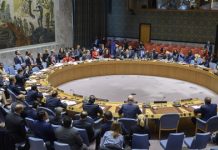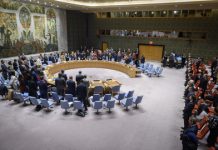

Addressing ambassadors, Finland’s Foreign Minister Elina Valtonen, who currently chairs the 57-nation OSCE, described the conflict as the gravest challenge to European security in decades and a direct assault on the foundations of the rules-based international order.
“Russia’s war of aggression against Ukraine is the largest and longest war in Europe since the Second World War,” she said. “In Ukraine, Russia is violating the UN Charter and each of the Helsinki principles.”
Ms. Valtonen traced those principles back to the 1975 Helsinki Final Act – a Cold War-era agreement signed by the United States, the Soviet Union and European nations that laid the groundwork for security cooperation. The accord affirmed, among other points, respect for borders, territorial integrity, non-use of force and fundamental human rights.
“The way this war ends will decisively shape the future of peace and stability not only in Europe, but across the world,” Ms. Valtonen warned, urging continued international support for Ukraine in achieving “a just and lasting peace.”
Regional diplomacy crucial
She also stressed the importance of cooperation between the OSCE and the United Nations, noting that their partnership allows regional diplomacy to reinforce the Security Council’s global role.
“Multilateral cooperation based on international law can and must be the bedrock for international peace and security. This is also what countries and peoples around the world expect,” she said.
Under Chapter VIII of the UN Charter, regional organizations such as the OSCE are encouraged to help prevent and resolve conflicts before they reach the Security Council, she added, describing such partnership as essential for peace and stability.
Focus on accountability
Accountability, she added, has remained central to Finland’s OSCE chairmanship, including addressing the unlawful deportation of Ukrainian children. Through the OSCE Support Program for Ukraine, the organization has helped register missing children and support their rehabilitation.
Beyond Ukraine, she outlined the OSCE’s wider regional engagement. In Moldova, she reaffirmed support for the Transnistria settlement process and in the South Caucasus, welcomed progress between Armenia and Azerbaijan.
She also highlighted engagement across Georgia, Central Asia and Southeastern Europe, including support for Bosnia and Herzegovina’s constitutional order, social dialogue in Serbia and efforts to resolve Kosovo’s political and institutional crisis.
Source of original article: United Nations (news.un.org). Photo credit: UN. The content of this article does not necessarily reflect the views or opinion of Global Diaspora News (www.globaldiasporanews.com).
To submit your press release: (https://www.globaldiasporanews.com/pr).
To advertise on Global Diaspora News: (www.globaldiasporanews.com/ads).
Sign up to Global Diaspora News newsletter (https://www.globaldiasporanews.com/newsletter/) to start receiving updates and opportunities directly in your email inbox for free.